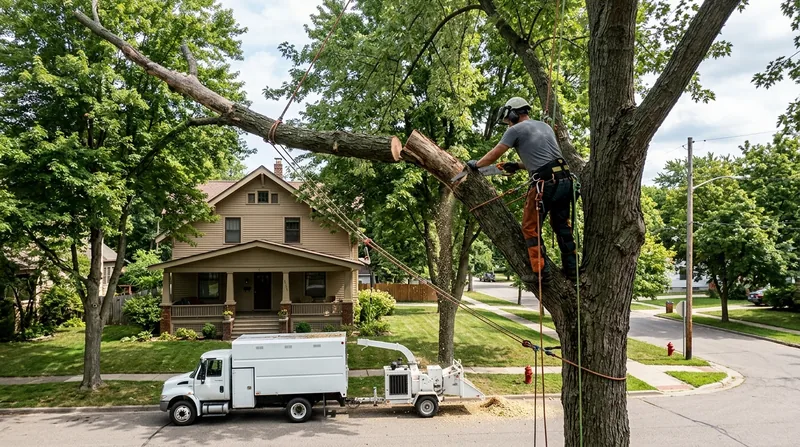




Lansing's tree-lined neighborhoods, from the Victorian-era homes along the Grand River in Old Town to the Craftsman bungalows on the Eastside and the wooded subdivisions of Okemos and Haslett, depend on mature shade trees to define their character and property values. Yet the region's heavy clay-loam soil, late-spring ice storms, summer thunderstorms with straight-line winds, and the lingering damage from emerald ash borer create constant pressure on tree structure and safety. Tree trimming and pruning in Lansing is not cosmetic work, it's preventive maintenance that keeps silver maples from dropping brittle limbs onto roofs, reduces storm damage risk, and prolongs the life of oaks, maples, lindens, and spruces that shade your home. Whether you're protecting a 1910s Craftsman home in Moores Park, clearing branches from a brick Tudor in Colonial Village, or managing the thick canopy on an older oak in Lansing's core neighborhoods, we handle the work with the precision and care that mature trees demand.
Why Tree Trimming & Pruning Matters in Lansing's Climate and Terrain
Lansing sits on a flat to gently rolling glacial plain where the Grand River and Red Cedar River meet, creating wet low spots and wooded floodplains that harbor dense tree growth. The region's weather cycle, from grey Great Lakes winters with heavy wet snow and December ice storms to humid green summers and brilliant autumn color, puts constant structural stress on trees. Silver maples, Norway maples, red and white oaks, and honeylocusts dominate residential canopies, but their limbs become brittle and prone to failure when ice accumulates or when storm winds exceed 40 mph. Dead ash trees left standing after emerald ash borer infestation are particularly hazardous, as are Norway maples showing tar spot decline and spruces weakened by needle cast. Proper pruning removes the branches most likely to fail, opens the crown to reduce wind resistance, and eliminates the dead wood that invites insect and disease entry.
- We remove deadwood and diseased branches that become projectiles in ice storms or summer thunderstorms common to the region.
- We thin crowns on mature silver and Norway maples to reduce the weight and wind load that cause failure over roofs and driveways.
- We clear branches from power lines, gutters, and sightlines to prevent utility damage and maintain home safety.
- We improve tree structure and health by removing crossing branches, reducing included bark, and opening the canopy to air and light.
- We follow ANSI A300 pruning standards to ensure cuts heal properly and do not invite decay or pest colonization.
Regular pruning extends tree lifespan, reduces emergency removal calls after storms, and protects your home and vehicles from the constant threat of limb failure in Lansing's volatile weather.
Lansing reality: The emerald ash borer killed thousands of ash street trees across the city in the 2000s and 2010s. Today, many properties still have standing dead ash, silver maple limbs hanging over roofs, and Norway maples showing decline from tar spot fungus. Pruning now prevents costly emergency removal and roof damage later.
For more on how storm damage threatens Lansing properties year-round, see our emergency tree service page. The City of Lansing's Parks and Recreation Division also publishes guidance on protected heritage trees and removal permits; check lansing.gov for current ordinances on trees above 6 inches DBH in certain districts.
How We Perform Tree Trimming & Pruning in Lansing: Our Process
Every trimming job starts with a clear assessment of the tree's species, age, health, and structural defects. We walk the property, identify branches that pose risk, evaluate proximity to structures and utilities, and explain our approach before we touch a saw. For large or hazardous trees, we may recommend a full arborist consultation to map out the best strategy. We use ropes, rigging, and bucket trucks when necessary to safely lower large limbs without damage to property. All debris is chipped on-site or hauled away, leaving your yard clean. We work in all seasons except during active sap flow on maples (late winter through early spring) and during the growing season when trees are most stressed.
- We inspect the tree for deadwood, disease, structural defects, and proximity hazards to nearby buildings, cars, and utilities.
- We discuss your goals, whether pruning for safety, health, structure, or clearance, and present our recommended approach.
- We prune using proper technique: heading cuts at branch collars, thinning cuts to reduce weight, and complete removal of deadwood and diseased material.
- We lower large limbs using ropes and rigging to protect your roof, deck, or garden below.
- We chip or haul all debris and leave the site clean and ready to use.
- We document the work and provide aftercare advice for your tree's recovery.
A typical small to medium pruning job on a 40-foot maple in East Lansing or Holt takes 2 to 4 hours. Larger jobs or multiple trees may require a full day or a return visit.
Local example: A homeowner on Moores River Drive in Lansing had a 60-year-old red oak with three large deadwood limbs hanging over the house. We removed the deadwood, thinned the crown by 20 percent to reduce wind load, and cleared the gutters. The work took one full day and cost $850. The tree is now structurally sound and will provide shade for another 30 years.
Pruning Methods and Approaches: What We Use
| Approach | Description | Best For |
|---|---|---|
| Crown Thinning | Selective removal of interior branches to reduce density, improve light penetration, and lower wind resistance. | Mature oaks, maples, and lindens; trees showing decline or disease; reducing storm damage risk. |
| Deadwood Removal | Complete removal of all dead, diseased, or broken branches back to living wood or the branch collar. | Any tree with visible deadwood; ash trees affected by emerald ash borer; post-storm cleanup. |
| Clearance Trimming | Removal of branches encroaching on power lines, roofs, gutters, sightlines, or neighboring property. | Utility clearance; roof and gutter protection; maintaining sight distance at driveways and intersections. |
| Structural Pruning | Removal of crossing branches, branches with included bark, and competing leaders to improve long-term form and reduce failure risk. | Young to middle-aged trees; trees with weak branch angles; preventive care for future safety. |
| Hazard Limb Removal | Targeted removal of large, heavy, or brittle limbs that pose immediate risk to structures, vehicles, or people. | Silver maples with brittle wood; trees with obvious structural defects; urgent safety situations. |
Tree Trimming & Pruning Cost in Lansing: What to Expect
Tree trimming and pruning in Lansing starts at $250 for small jobs like removing deadwood from a 20-foot ornamental tree or clearing a few branches from a gutter. Mid-size jobs on 40 to 60-foot shade trees typically range from $400 to $1,200 depending on the complexity, access, and whether rigging or bucket truck work is needed. Large or multi-tree projects, hazard limb removal, or work on trees with structural disease may run $1,500 to $3,000 or higher. Several factors affect the final price: tree height and crown size, wood density and species (oak and maple are denser and harder to cut than ash or birch), proximity to structures or utilities, ground access for equipment, and whether the tree shows signs of disease or structural defect that requires extra care.
We always recommend getting two or three estimates from insured contractors. Prices vary based on crew experience, equipment, and how the contractor assesses risk. A low bid may mean faster work but less attention to tree health or safety. Our estimates include a detailed scope, the arborist's reasoning, and a firm price with no surprises. For a full breakdown of pricing by service type and job size, visit our pricing page. Call us at (517) 888-9633 for a free estimate, no obligation.
What to Look for When Hiring a Tree Service Near Lansing
Not all tree services in Lansing are created equal. Some contractors use aggressive pruning techniques that wound trees or remove too much canopy, leaving them stressed and vulnerable to disease. Others lack proper insurance or work without understanding local permit requirements. When you call a tree service, ask for proof of current liability and workers' compensation insurance. Request references from recent jobs in your neighborhood, whether Lansing, East Lansing, Okemos, Haslett, Holt, or another surrounding area. Check whether the contractor knows about Lansing's heritage tree ordinances and can guide you through the permit process if your tree is protected. Many HOAs in Colonial Village, Moores Park, and newer subdivisions require approval before visible tree work. Ask the contractor if they will chip debris on-site or haul it away, what their cleanup standard is, and whether they offer a warranty on the pruning work.
- Verify current license and insurance by asking for certificates before work begins.
- Request references from at least two recent jobs and follow up with those homeowners.
- Confirm the contractor understands local permit rules for protected trees and heritage species in your city or neighborhood.
- Ask whether HOA approval is needed for your property and whether the contractor will help navigate that process.
- Get the estimate in writing with a detailed scope, species, tree location, and the exact work to be performed.
- Avoid contractors who quote over the phone without seeing the tree or who pressure you to book immediately.
Contact us today to schedule a walk-through and get a no-obligation quote for your tree trimming or pruning project.
Tree Trimming & Pruning in Lansing: Pricing Guide
| Service | Price | Details |
|---|---|---|
| Small deadwood or clearance trim | Starting at $250 | Removal of dead branches, single limb clearance from gutters or lines on trees under 35 feet tall. |
| Crown thinning or mid-size pruning | Starting at $450 | Selective thinning on 40 to 60-foot shade trees, structural pruning, hazard limb removal on mature oaks and maples. |
| Large tree or multi-tree project | Starting at $1,200 | Full crown work on multiple trees, hazard removal on trees over 70 feet, or complex rigging over structures and utilities. |
| Emergency or storm damage cleanup | On estimate | Same-day or next-day response required; pricing depends on limb size, debris volume, and access complexity. |
| Travel and site visit | Included | No separate mileage fee within Lansing and surrounding service areas including East Lansing, Okemos, Haslett, Holt, and DeWitt. |
| Free estimate | Free | No obligation, response within 24 hours, detailed scope and pricing in writing; call (517) 888-9633 anytime. |
Indicative pricing, the exact cost depends on square footage, finish, and site access. Free personalized estimate within 24h at (517) 888-9633.


